
Loading...
Loading...
Tempered glass shatters into safe granules; laminated holds together when broken. Compare strength, safety, cost, and the building codes that require each.
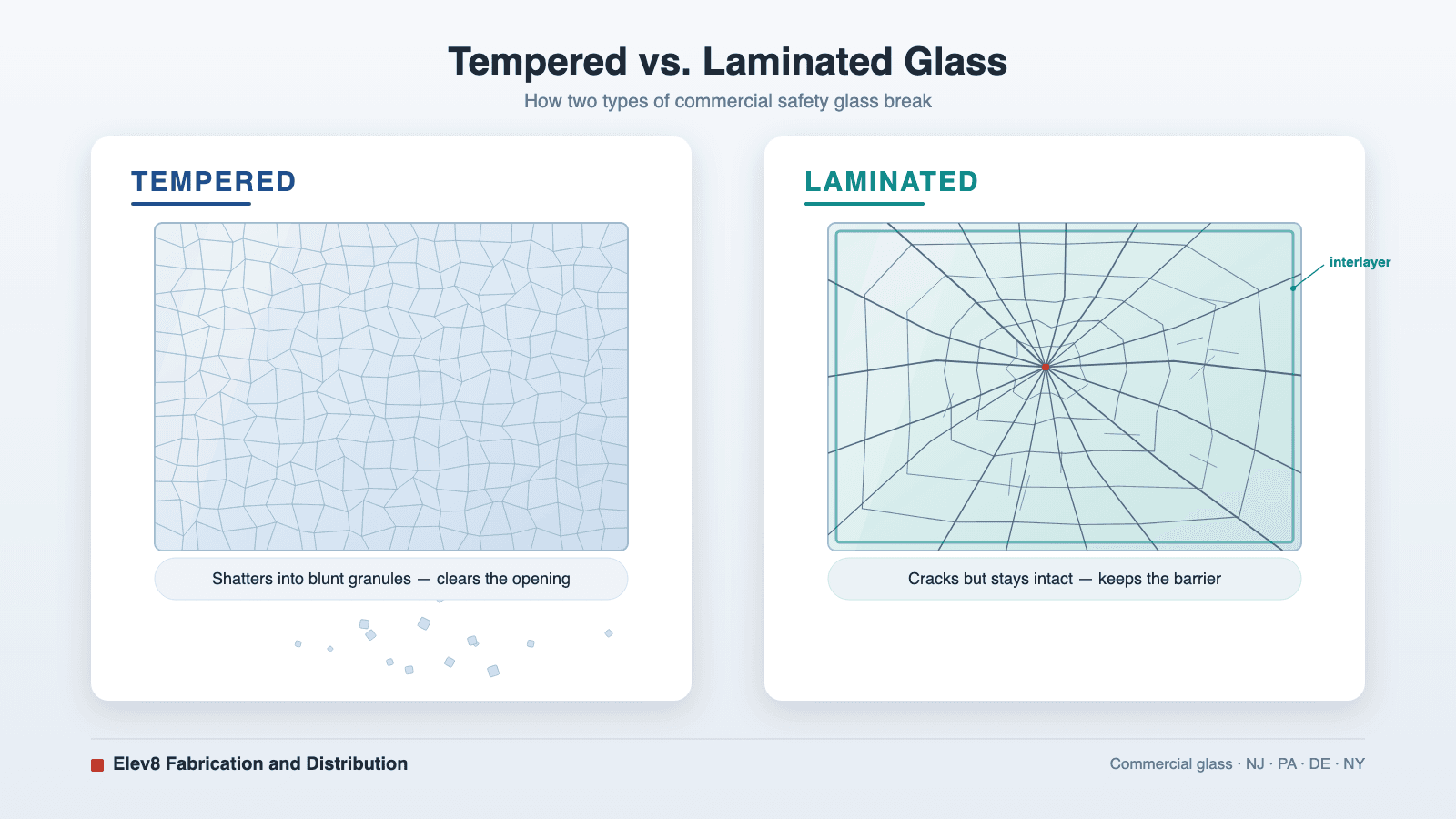
Tempered glass and laminated glass are both code-recognized safety glazing, but they fail in opposite ways. Tempered glass shatters into small, blunt granules that fall out of the opening. Laminated glass cracks but its plastic interlayer holds the fragments in place, keeping the opening covered. That single difference — whether the glass leaves the frame or stays put — drives almost every decision about which one a commercial project should use.
Elev8 Fabrication and Distribution supplies and fabricates both for commercial projects across South Jersey, Greater Philadelphia, and the Delaware Valley. This guide compares them across the factors that actually decide a spec: safety, strength, sound, UV, cost, and — most importantly — what the building code requires.
For the fundamentals of tempered glass on its own, see What Is Tempered Glass?.
Choose tempered when you need strong, low-cost safety glazing that shatters harmlessly — entrance doors, sidelites, shower enclosures, and most storefront glazing. Choose laminated when the glass must stay in the opening after it breaks — overhead and sloped glazing, glass guards and railings, hurricane-impact zones, security glazing, and sound-sensitive facades. Many of those laminated applications aren't a preference; they're required by code.
When tempered glass fails, the surface compression is breached and the whole pane dices at once into small, blunt fragments. Those fragments are far safer than annealed shards, but they generally do not stay in the frame — the opening is left clear.
Laminated glass is built from two or more lites of glass permanently bonded to a plastic interlayer. When it breaks, the glass cracks in a "spider-web" pattern but the interlayer retains the fragments, so the panel stays intact and continues to act as a barrier until it's replaced. Both products meet the same federal safety floor (CPSC 16 CFR 1201 and ANSI Z97.1); they simply satisfy it through opposite failure modes.
Tempered glass is heated to roughly 1,150–1,200°F and rapidly quenched, placing its surfaces in compression and its core in tension.
Laminated glass is assembled by bonding glass lites to an interlayer under heat and pressure in an autoclave. The interlayer choice matters:
Laminated glass can be built from annealed, heat-strengthened, or fully tempered lites — the interlayer works independently of whether the glass itself is heat-treated.
This is where the choice is usually made for you. The International Building Code (IBC) mandates laminated glass in the applications where retained fragments matter most:
"Tempered vs. laminated" is a bit of a false choice — the two aren't mutually exclusive. You choose the glass treatment (annealed, heat-strengthened, or fully tempered) *and* decide whether it needs an interlayer:
A short framework for commercial specs:
Which IBC edition applies depends on where the project sits. New Jersey and Pennsylvania have adopted the 2021 IBC statewide. Delaware has no statewide adoption — the applicable code is set county by county (New Castle and Sussex counties are on the 2021 IBC/IRC, while some jurisdictions remained on the 2018 edition). Because the glass-guard requirement changed with the 2015 IBC, the edition your jurisdiction enforces can determine whether monolithic tempered glass is still permitted in a given railing. When in doubt, confirm the adopted edition with the local authority having jurisdiction.
Elev8 Fabrication and Distribution stocks, fabricates, and supplies both tempered and laminated glass — cut and prepared to spec — for commercial projects across NJ, PA, DE, and NY. Explore our commercial glass products, review technical documentation in our resources library, or request a quote with your glazing schedule.
Published on July 6, 2026
Not necessarily — they measure "strength" differently. Tempered glass is 4–5× more impact-resistant than annealed glass. Laminated glass may use weaker or stronger lites, but its advantage is retention: it holds together and stays in the opening after breaking, which tempered glass does not.
Laminated glass typically costs more than tempered glass of the same size. It's built from multiple glass lites bonded to a plastic interlayer in an autoclave, so both materials and processing add cost. The exact difference depends on the interlayer type, lite composition, and thickness.
Yes. Laminated glass can be built from fully tempered or heat-strengthened lites, giving you both retention and added strength. In fact, building codes require laminated glass made from tempered or heat-strengthened glass for guards and railings, and heat-strengthened laminated is common for overhead glazing.
Laminated. Since the 2015 IBC, glass guards and railings generally must be laminated glass built from tempered or heat-strengthened lites, so a broken panel stays intact as a barrier. Monolithic tempered glass is allowed only where nothing walks beneath the guard.
Yes. Both meet the federal architectural glazing safety standard, CPSC 16 CFR 1201, and ANSI Z97.1 — they simply pass it differently. Tempered breaks into small, blunt granules, while laminated holds its fragments in place. Building codes accept either as safety glazing where retention isn't specifically required.
Contact our team to learn more about our products and services, or request a quote for your next project.